Overview
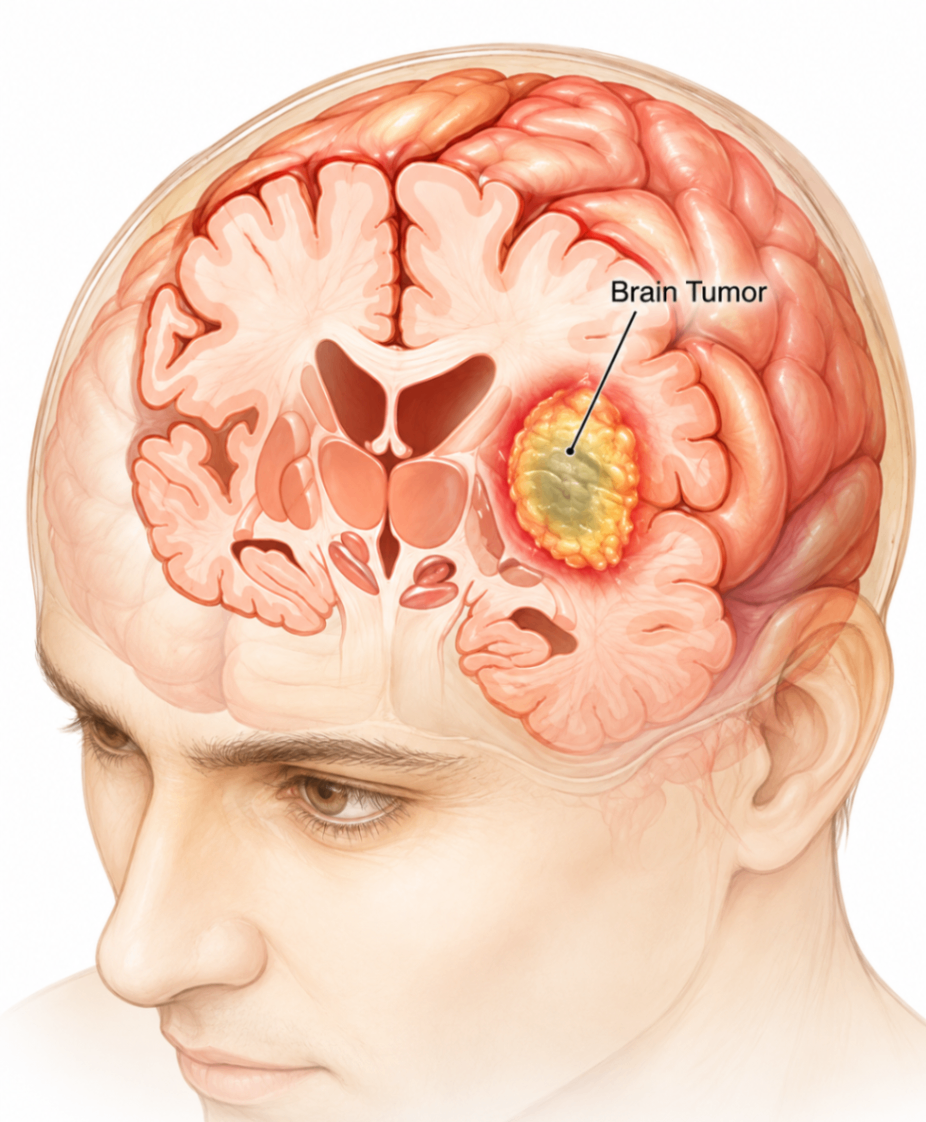
A brain tumor is a growth of cells in the brain or near it. Brain tumors can happen in or near the brain tissue. Nearby areas where brain tumors can happen include nerves, the pituitary gland, the pineal gland and the membranes that cover the surface of the brain.
Brain tumors can begin in the brain. These are called primary brain tumors. Sometimes, cancer spreads to the brain from other parts of the body. These tumors are secondary brain tumors, also called metastatic brain tumors.
There are many different types of primary brain tumors. Some brain tumors are not cancer. These are called noncancerous brain tumors or benign brain tumors. Noncancerous brain tumors may grow over time and press on the brain tissue. Other brain tumors are brain cancers, also called malignant brain tumors. Brain cancers may grow quickly. The cancer cells can invade and destroy brain tissue.
Brain tumors range in size from very small to very large. Some brain tumors are found when they are very small because they cause symptoms that you notice right away. Other brain tumors grow very large before they're found. Some parts of the brain are less active than others. If a brain tumor starts in a part of the brain that's less active, it might not cause symptoms right away. The brain tumor could become quite large before the tumor is found.
Brain cancers and brain tumors are not classified by stage as some types of cancer are. Brain tumors are graded from 1 to 4 based on a classification system of the World Health Organization (WHO). Grade 1 brain tumors are the least aggressive and grow slowly. Grade 4 brain tumors are the most aggressive and grow quickly. Grade 4 tumors are typically more difficult to treat and have lower survival rates than lower grade tumors.
Brain tumor treatment options depend on the type of brain tumor you have, as well as its size and location. Common treatments include surgery and radiation therapy.
Types of Brain Tumor
There are many types of brain tumors. The type of brain tumor is based on the kind of cells that make up the tumor. Special lab tests on the tumor cells can give information about the cells. Your healthcare team uses this information to figure out the type of brain tumor.
Some types of brain tumors usually aren't cancerous. These are called noncancerous brain tumors or benign brain tumors. Some types of brain tumors usually are cancerous. These types are called brain cancers or malignant brain tumors. Some brain tumor types can be either benign or malignant.
Benign brain tumors tend to be slow-growing brain tumors. Malignant brain tumors tend to be fast-growing brain tumors.
1. Gliomas and related brain tumors.
Gliomas are growths of cells that start in glial cells. The glial cells surround and support nerve cells in the brain tissue. Types of gliomas and related brain tumors include astrocytoma, glioblastoma, oligodendroglioma and ependymoma. Gliomas can be benign, but most are malignant. Glioblastoma is the most common type of malignant brain tumor.
2. Choroid plexus tumors.
Choroid plexus tumors start in cells that make the fluid that surrounds the brain and spinal cord. This fluid is called cerebrospinal fluid. Choroid plexus tumors are located in the fluid-filled cavities in the brain, called the ventricles. Choroid plexus tumors can be benign or malignant. Choroid plexus carcinoma is the malignant form of this type of brain tumor. It's more common in children.
3. Embryonal tumors.
Embryonal tumors begin in cells that are left over from fetal development. The cells, called embryonal cells, stay in the brain after birth. Embryonal tumors are malignant brain tumors that happen most often in babies and young children. The most common type of embryonal tumor is medulloblastoma. These tumors are usually located in the lower back part of the brain, called the cerebellum.
4. Germ cell tumors.
Germ cell tumors start in reproductive cells, called germ cells, that go on to become sperm and egg cells. Germ cells are mostly in the ovaries and testicles. But sometimes they're in other parts of the body, including the brain. When germ cell tumors happen in the brain, they're often located near the pineal gland, which is located in the center of the brain, or the pituitary gland, which is located near the base of the brain. Germ cell tumors are mostly benign. They're more common in children.
5. Pineal tumors.
Pineal tumors start in and around the brain's pineal gland. It makes a hormone called melatonin that helps with sleep. Pineal tumors can be benign or malignant. Pineoblastoma is a malignant type of pineal tumor that's most common in children.
6. Meningiomas.
Meningiomas are brain tumors that start in the membranes around the brain and spinal cord. Meningiomas are usually benign, but sometimes they can be malignant. Meningiomas are the most common type of benign brain tumor.
7. Nerve tumors.
Nerve tumors are growths that happen in and around nerves. The most common type that happens in the head is acoustic neuroma, also called schwannoma. This benign tumor is located on the main nerve that connects the inner ear to the brain.
8. Pituitary tumors.
Brain tumors can begin in and around the pituitary gland. Most tumors that happen in and around the pituitary gland are benign. Pituitary tumors happen in the pituitary gland itself. Craniopharyngioma is a type of brain tumor that happens near the pituitary gland.
Other brain tumors.
Many other types of rare tumors can happen in and around the brain. Tumors can start in the muscles, blood vessels and connective tissue around the brain. Tumors can form in the bones of the skull. Malignant brain tumors can start from the germ-fighting immune system cells in the brain. This type of brain cancer is called primary central nervous system lymphoma.
Book Appointment
Symptoms
The signs and symptoms of a brain tumor depend on the brain tumor's size and location. Symptoms also might depend on how fast the brain tumor is growing, which is also called the tumor grade.
General signs and symptoms caused by brain tumors may include:
- Headache or pressure in the head that is worse in the morning.
- Headaches that happen more often and seem more severe.
- Headaches that are sometimes described as tension headaches or migraines.
- Nausea or vomiting.
- Eye problems, such as blurry vision, seeing double or losing sight on the sides of your vision.
- Losing feeling or movement in an arm or a leg.
- Trouble with balance.
- Speech problems.
- Feeling very tired.
- Confusion in everyday matters.
- Memory problems.
- Having trouble following simple commands.
- Personality or behavior changes.
- Seizures, especially if there is no history of seizures.
- Hearing problems.
- Dizziness or a sense that the world is spinning, also called vertigo.
- Feeling very hungry and gaining weight.
Noncancerous brain tumors tend to cause symptoms that develop slowly. Brain tumors that aren't cancer also are called benign brain tumors. They might cause subtle symptoms that you don't notice at first. The symptoms might get worse over months or years.
Cancerous brain tumors cause symptoms that get worse quickly. These tumors also are called brain cancers or malignant brain tumors. They cause symptoms that come on suddenly. The symptoms get worse in a matter of days or weeks.
Brain tumor headaches
Headaches are the most common symptom of brain tumors. Headaches happen in about half of people with brain tumors. Headaches can happen if a growing brain tumor presses on healthy cells around it. A brain tumor also can cause swelling in the brain that increases pressure in the head and leads to a headache.
Headache pain caused by brain tumors is often worse when you wake up in the morning. But it can happen at any time. Some people have headaches that wake them from sleep. Brain tumor headaches tend to cause pain that's worse when coughing or straining. People with brain tumors most often report that the headache feels like a tension headache. Some people say the headache feels like a migraine.
Brain tumors in the back of the head might cause a headache with neck pain. If the brain tumor happens in the front of the head, the headache might feel like eye pain or sinus pain.
Brain tumor symptoms by location
The main part of the brain is called the cerebrum. Brain tumors in different parts of the cerebrum might cause different symptoms.
Diagnosis and Treatment
If your healthcare professional thinks you might have a brain tumor, you'll need a number of tests and procedures to get a diagnosis. These might include:
- A neurological exam. A neurological exam tests different parts of your brain to see how they're working. This exam may include checking your vision, hearing, balance, coordination, strength and reflexes. If you have trouble in one or more areas, this is a clue for your healthcare professional. A neurological exam doesn't detect a brain tumor. But it helps your healthcare professional understand what part of your brain might be causing your symptoms.
- Head CT scan. A CT scan uses X-rays to make pictures. It's widely available, and results come back quickly. So CT might be the first imaging test that's done if you have headaches or other symptoms that have many possible causes. A CT scan can detect problems in and around your brain. The results give your healthcare professional clues to decide what test to do next. If your healthcare professional thinks your CT scan shows a brain tumor, you might need a brain MRI.
- Brain MRI. MRI, uses strong magnets to create pictures of the inside of the body. MRI is often used to detect brain tumors because it shows the brain more clearly than other imaging tests.
- Often a dye is injected into a vein in the arm before an MRI. The dye makes certain details more clear and makes it easier to see smaller tumors. It can help your healthcare team see the difference between a brain tumor and healthy brain tissue.
- Sometimes you need a special type of MRI to create more-detailed pictures. One example is functional MRI. This special MRI shows which parts of the brain control speaking, moving and other important tasks. This helps your healthcare professional plan surgery and other treatments.
- Another special MRI test is magnetic resonance spectroscopy. This test uses MRI to measure levels of certain chemicals in the tumor cells. Having too much or too little of the chemicals might tell your healthcare team about the kind of brain tumor you have.
- Magnetic resonance perfusion is another special type of MRI. This test uses MRI to measure the amount of blood in different parts of the brain tumor. The parts of the tumor that have a higher amount of blood may be the most active parts of the tumor. Your healthcare team uses this information to plan your treatment.
- PET scan of the brain. A positron emission tomography (PET) scan can detect some brain tumors. A PET scan uses a radioactive tracer that's injected into a vein. The tracer travels through the blood and attaches to brain tumor cells. The tracer makes the tumor cells stand out on the pictures taken by the PET machine. Cells that are dividing and multiplying quickly soak up more of the tracer.
- A PET scan may be most helpful for detecting brain tumors that are growing quickly. Examples include glioblastomas and some oligodendrogliomas. Brain tumors that grow slowly, such as those that aren't cancerous, might not be detected on a PET scan. Not everyone with a brain tumor needs a PET scan. Ask your healthcare professional whether you need a PET scan.
- Collecting a sample of tissue. A brain biopsy is a procedure to remove a sample of brain tumor tissue for testing in a lab. Often a surgeon gets the sample during surgery to remove the brain tumor.
- If surgery isn't possible, a sample might be removed with a needle. Removing a sample of brain tumor tissue with a needle is done with a procedure called stereotactic needle biopsy.
- During this procedure, a small hole is drilled in the skull. A thin needle is inserted through the hole. The needle is used to take a tissue sample. Imaging tests such as CT and MRI are used to plan where the needle will go. You won't feel anything during the biopsy because medicine is used to numb the area. Often you also receive medicine that puts you in a sleeplike state so you're not aware.
- You might have a needle biopsy rather than surgery if your healthcare team is worried that an operation might hurt an important part of your brain. A needle might be needed to remove tissue from a brain tumor if the tumor is in a spot that's hard to reach with surgery.
- Brain biopsy has a risk of complications. Risks include bleeding in the brain and damage to the brain tissue.
- Testing the tissue sample in the lab. The biopsy sample is sent to a lab for testing. Tests can see whether the cells are cancerous or not cancerous. The way the cells look under a microscope can tell your healthcare team how quickly the cells are growing. This is called the brain tumor's grade. Other tests can find out what DNA changes are present in the cells. This helps your healthcare team create your treatment plan.
Brain tumor care at Global Neuro and Spine care